1. Introduction
Australia’s disability support sector has grown rapidly — and the National Disability Insurance Scheme (NDIS) is a big reason why. For founders and investors, the big question is whether you should start from scratch or buy an existing provider.
- Starting usually costs less, but takes longer to build trust and referrals.
- Buying is faster, but you inherit systems, staff dynamics, and compliance history.
- Either way, your long-term value is driven by documentation, quality, and audit readiness.
2. What Is an NDIS Business?
The NDIS is a government-funded program that supports Australians living with permanent and significant disabilities. An “NDIS business” delivers approved services and is paid via NDIS funding (either through plan-managed, self-managed, or NDIA-managed arrangements depending on the service and provider).
Common Types of NDIS Businesses
- Support coordination
- In-home support / disability support workers
- Allied health (OT, speech, psychology)
- Supported Independent Living (SIL)
- Short-term accommodation (STA / respite)
- Group homes
- Specialist Disability Accommodation (SDA)
3. Key Differences: Starting vs Buying
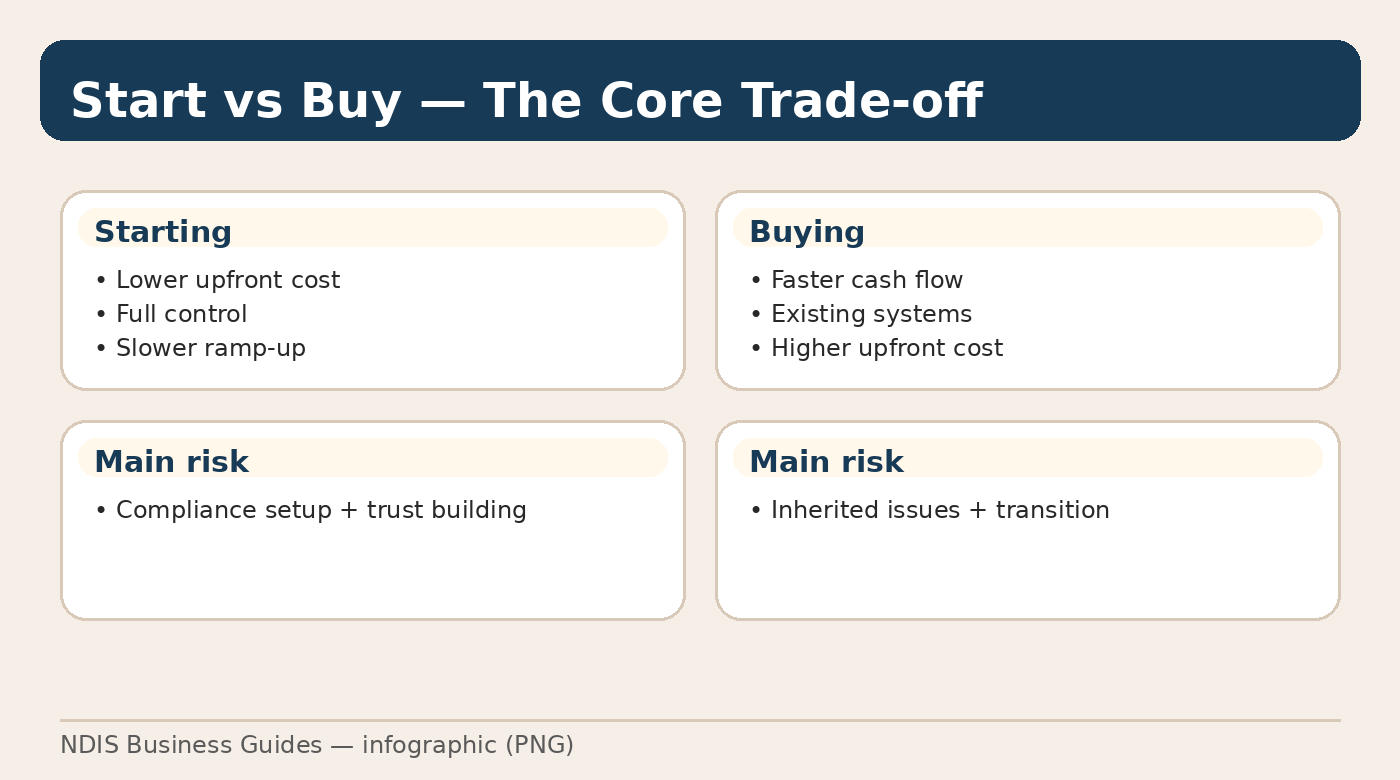
Starting
- Build policies, systems, referrals, and team from zero
- More control over culture
- Slower ramp to profitability
Buying
- Acquire clients, revenue, and operating history
- Faster entry and often easier to finance
- Must manage inherited risks
Rule of thumb: Starting trades time for money. Buying trades money for speed and (often) more certainty.
4. Pros & Cons of Starting
Pros
- Lower upfront cost compared to acquisitions.
- Clean compliance slate and modern systems from day one.
- Culture control — hire and train to your standard.
Cons
- Time to revenue — often 6–18 months to stable referrals.
- Upfront compliance workload before meaningful income.
- Harder early trust with plan managers and coordinators.
5. Pros & Cons of Buying
Pros
- Immediate cash flow from existing participants.
- Operating systems and staff already in place.
- Historical financials support more predictable planning.
Cons
- Higher capital requirement (plus due diligence costs).
- Inherited risk — audits, complaints, reputation, processes.
- Transition risk — staff and client retention through handover.
6. Cost Comparison
Typical start-up costs
- Registration and audit: $8,000 – $20,000
- Policies, consulting, documentation: $5,000 – $15,000
- Insurance: $5,000 – $10,000
- Recruitment and training: $10,000+
- Marketing and referrals: $5,000 – $20,000
Estimated total: 💰 $30,000 – $80,000+
Typical acquisition costs
- Purchase price often: 2.5x – 4x EBITDA
- Legal + due diligence: $20,000 – $50,000
- Working capital buffer: 3–6 months
Estimated total: 💰 $300,000 – $3,000,000+
7. Decision Checklist
- Do I have sector experience (or a strong operator to hire)?
- How much capital can I commit without stressing cashflow?
- Can I tolerate a ramp-up period with lower revenue?
- Am I comfortable with audits, incident reporting, and governance?
- Do I want a small lifestyle provider or a scalable platform?
8. How to Evaluate a Purchase
Do not buy based on revenue alone. Validate what drives it, how stable it is, and whether it survives a change of ownership.
What to review
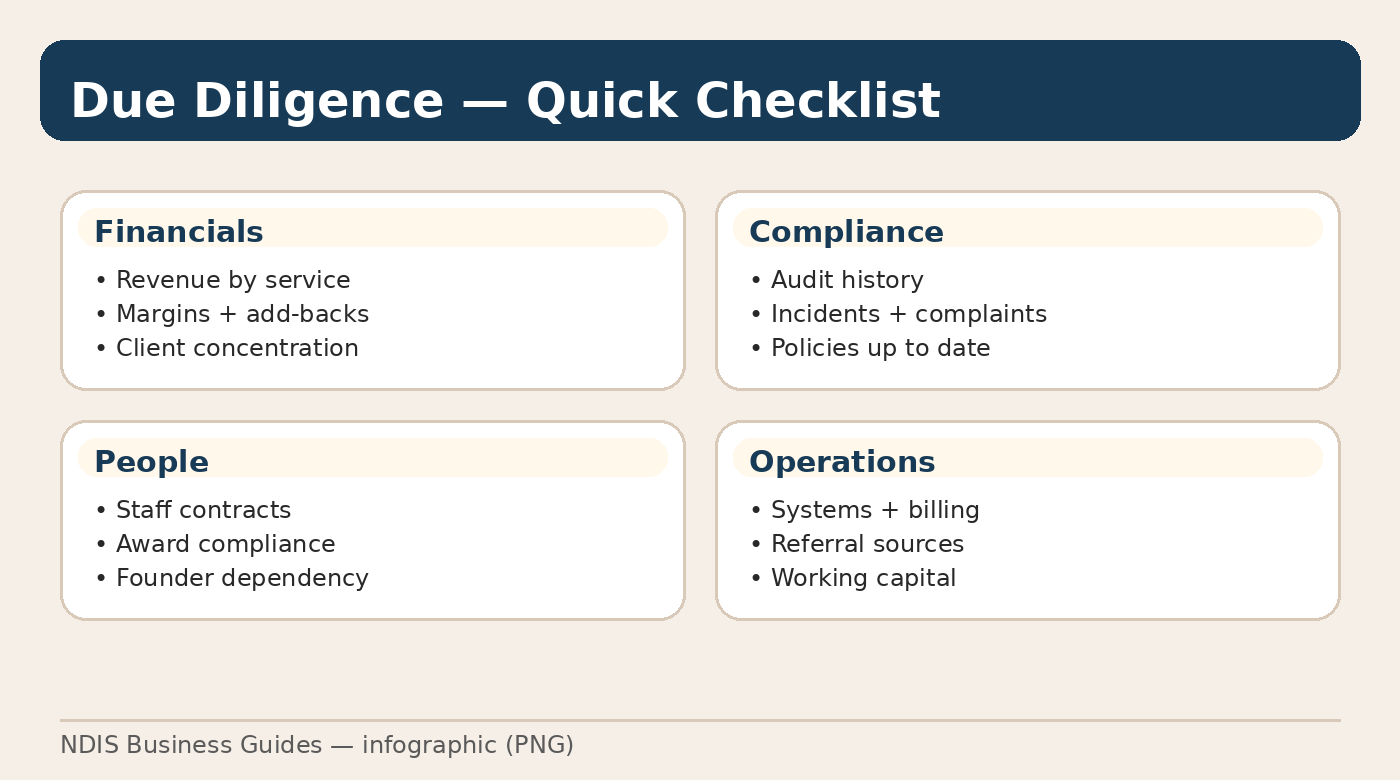
- Financials: margins, billing accuracy, service mix, contractor ratios.
- Clients: concentration risk, tenure, referral sources, churn history.
- Compliance: audits, incidents, complaints, quality management system.
- People: awards compliance, key-person risk, turnover, rosters.
Common red flags
- 🚩 Founder is essential for daily delivery
- 🚩 Poor documentation or missing policies
- 🚩 High staff turnover or weak recruitment pipeline
- 🚩 Inconsistent billing or unexplained revenue spikes
- 🚩 Large dependence on 1–2 participants
9. Legal & Compliance Checklist
- NDIS Practice Standards alignment
- Worker screening and role-based checks
- Incident management and reportable incidents processes
- Insurance: public liability, professional indemnity, workers comp
- Documented policies + evidence of staff training
In practice, compliance failures can destroy value fast — even for high-revenue providers.
10. Conclusion
There’s no universal “better” option — only what fits your budget, timeline, and risk tolerance. Many owners start small, then buy competitors once referrals and governance are stable.